
Night School
an interview with Erin Honeycutt

Erin Honeycutt’s new book Night School is hot off the presses of the Bretagne-based Ma Bibliothèque. The new title give us something very different from the deconstructed epistolary poem found in the writer’s recently published chapbook Dear Enheduanna, : delicious, delirious prose that rides off the roads of normal time, making us slip and slide back and forth between memory, dream, and image — giving us the idea of poem.
Reading Night School, I think back to Zoe Tuck’s workshop “Like Dreamers Do” and particularly the texts “The Eyelid” by SD Chrostowska and Soleida' Ríos’s “The Dirty Text” [El texto sucio] which defy genre in a similar way that Erin’s Night School does specifically because they take dream as their point of departure and in dream there is no genre! This book also brought me back to ekphrasis — writing the image — and reminded me that, like other artforms, writing is a craft in which we make something appear in the world in a way that this thing did not exist before, but always in relation to what precedes and follows it.
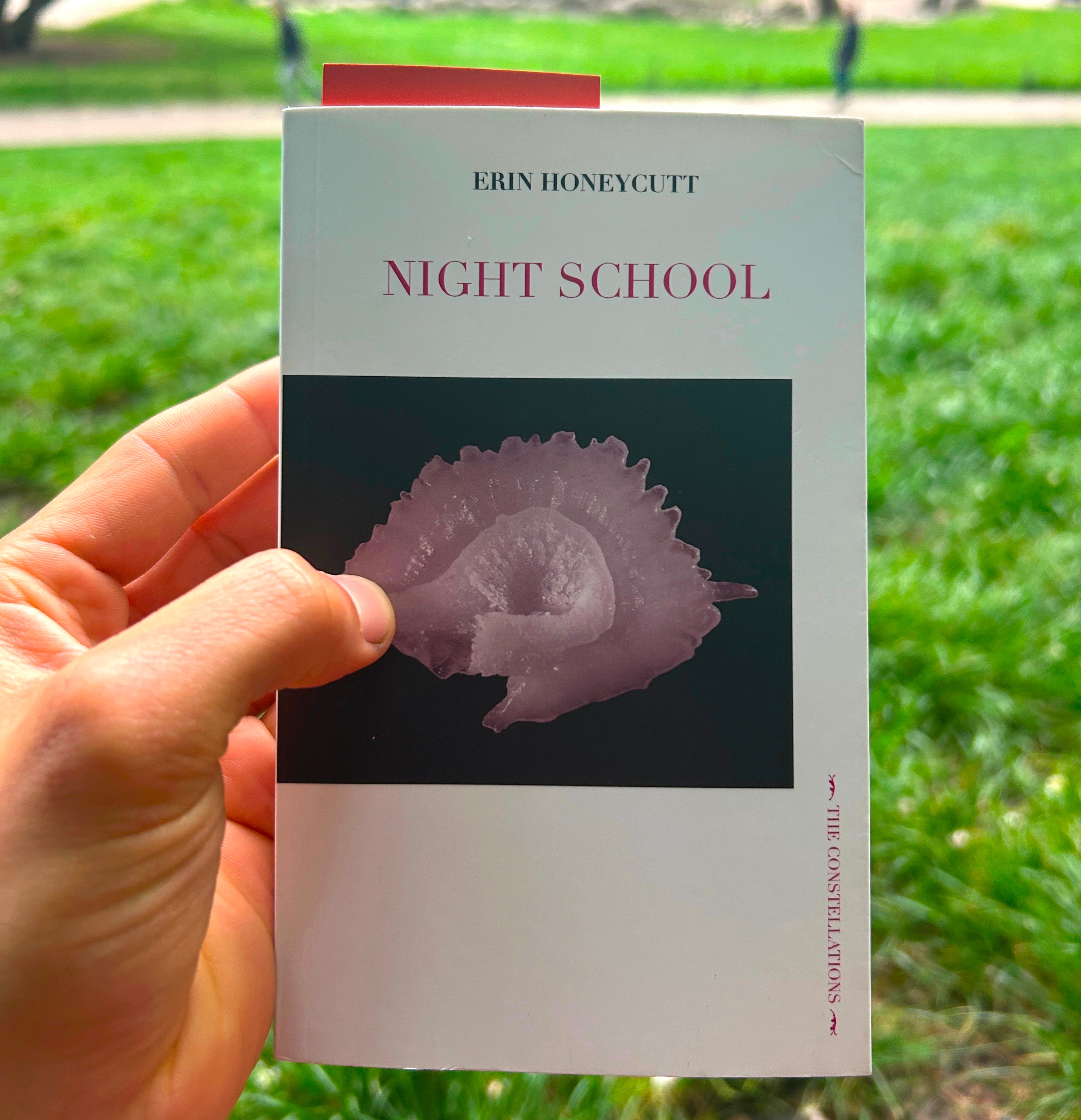
Today, friends, I wish to share with you some quick thoughts after my reading of Night School and a brief interview with its author, whose artistic practice spills into the world of publishing via Cutt Press. My thoughts revolve around the symbology of the egg, mother, and being baby, while our interview touches on dream, astrology, and desire.
Get your hands on Night School in a bookstore near you <3 and if you like what you’re reading, please consider becoming a paid subscriber to Darian Razdar’s New Letter <3
*
In the centre of Night School, there is an egg. It is the gravitational centre around which the rest of its bodies orbit. In “Egg,” Erin writes :
“There is a giant egg on top of a snowy mountain. The creature inside is pecking its way out from the top of the shell. The cracking of the egg with the beak of the creature inside is the rhythm.”
If an egg cracking and is the rhythm, and rhythm is a dancer, then I am its humble student. Let me be the one who follows along step by step, beat by beat ; and let me be the one who dips my finger slightly into its golden yoke!
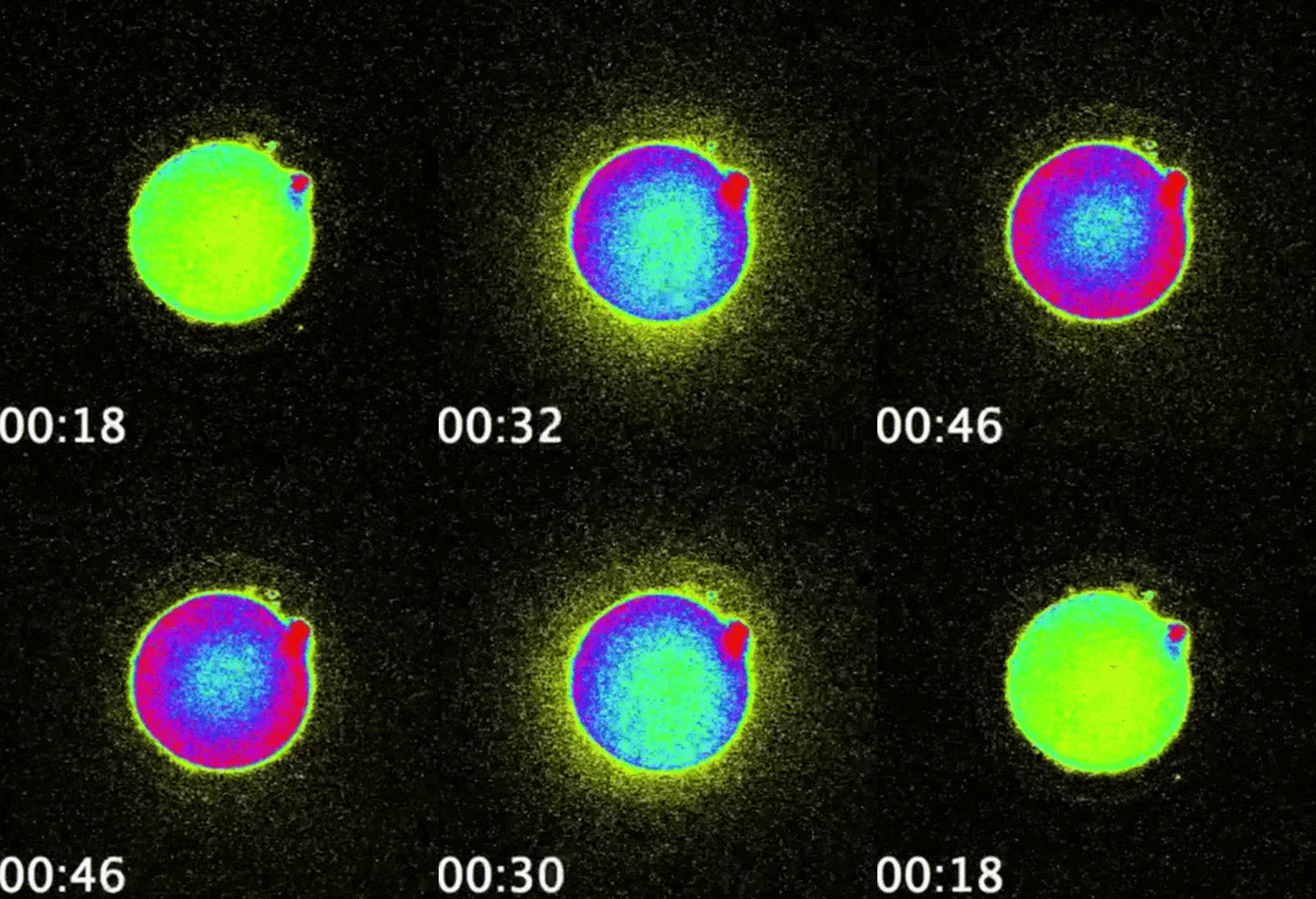
In another way, it feels like inside Night School there is an ovule. There is an ovule who is waiting to be shed, but somehow in its waiting gets stuck. The “i” of these poems is that lodged egg and at the same time the “i” is trying to unstick it. So, this book has a totally uncomfortable relationship with reproduction, which reminds me of the green zinc spark that happens at conception when two gametes meet in the forever nighttime laying inside a body. My mind being conditioned in the early century’s american cultural slosh brought back the image of Gaga’s extraterrestrial egg entrance as well as the Black Moon that divulges a secret cosmology at the end of Neon Genesis Evangelion.


I love this book because it makes me ask myself about my relationship with reproduction at a time in my life (the edge of 30) when I’m supposed to be settling down and having kids. It makes me think about about my experience being offspring, having been an egg and now being me, the question of making offspring, springing off, offing spring. If you’re thinking “I’m baby” while reading this, that’s good because I am too! I’m a real baby and I’m crying blinded by the light. And what does baby do with their new body and the stories written by blood? I love how Night School navigates the physiological and philosophical dimensions of this. In the chapter entitled “(M)OTHER A FERAL RELATIONSHIP” we read :
"The most extreme

Offspring as (m)others supreme monster of
consciousness
the offspring will use the other to break
themself against
A foil to further a mask
Either a new mask or the falling of an old
Definition of love in a feeling body
. . . .
Writing as a refusal of being written by blood.
 The more definite the split,
the closer to the Real.
Home like a cord, saying Dear..."


*
Darian Razdar : Night School is a book in dialogue with the realm of dreams. I was recently considering the way language takes shape in dreams. My first question for you is, what tongue do you dream in and what is your relationship between language and dream?
Erin Honeycutt : Dear Darian, thank you for these questions and for taking some time with the book. I can remember many dreams in which I wake up with some kind of residue in my mouth and on my tongue from something I was saying in my dream like waking up took the form out of the language and it became like the ghost of the language. I think language in dreams is definitely about the body speaking not just the language center of the brain. Sometimes it has felt distinctly like I could speak Greek or Hungarian - tongues I don’t speak - in the dream and upon waking just forgot how to speak them. Like tongue muscle memory Déjà vu. I feel like the dream in general is a function of the brain body which has its own language in the unconscious in the form of images but when written languages and spoken languages become involved it feels like we’re getting at the real Night School which is some place where text and image are read seemlessly, which is I suppose some kind of animist perception of the world where you can behold the flower and speak flower and read flower without spelling out d a n d e l i o n.
Some parts of Night School were written in 2020 when there were some early versions of large language models and one that I was curious about is called Sudowrite which had a function in which it could receive any sentence and describe that sentence using the five senses of whatever algorithm it was based on - I actually didn’t look too much into the company as at the time AI and writing wasn’t quite talked about like it is now. I was curious to see how it would describe my dream images using the five senses - how did the dream smell, taste, feel, look, sound, as some kind of interpretation. Of course I could do this myself, but I was curious about how the algorithm would spell it out as some kind of dreaming body like there was a media archaeology body. I prefer the human body, don’t get me wrong!
There are other parts of the book like the story of translation between fingers and tongues in the theater toilet bathroom that began with an actual dream that I was merely describing and continued the sequence after the events in the dream had ended, also as a way to process parts of it in relation to my waking life, gather meanings and connections, maybe writing is in a way a grappling with an inner image as a dialogue with it.
My mom told me as a kid I was always laughing like crazy while sleeping and remembered nothing about it upon waking but I do remember feeling the residue of the laughter in my mouth only I had forgotten the joke!
DR : There is definitely something to be learned from one’s dialogues with the dream realm, but that knowledge or understanding is hidden: in the chapter entitled “INTERLUDE,” you write “Night school became catching what cannot be seen.” In her essay “The School of Dreams” Hélène Cixous asks “What Must We Do To Get to the School of Dreams?” and then likens the School of Dreams to a game of cat and mouse in which we might “suppose that the mouse has a great desire to be eaten.” Who is the cat and who is the mouse of Night School, does the mouse desire to be eaten and if so why, and What Must We Do To Get There?
EH : I have definitely been reading Cixous’ Three Steps on the Ladder of Writing over the last few years. In that interlude I was trying to explain this sensation of the mesh that collapses when there is no binary, as though in my imagination the mesh on which projections of —- life (?)—- are seen and shared was created by these invisible taut strings, and when they collapse we have to find a new filter that is more attuned to tonalities and subtleties and the poly and the multiple and the between translation. Perhaps even misunderstanding as its own tone to perceive with. I think Night School is a tracking of attuning to an understanding of this filter which is a rewriting of inherited scripts around gender, time, knowledge. So the cat and the mouse stop chasing each other and um learn each others’ language of play and affection and they create new games together for understanding each other better, using a wheel of consent perhaps (!) Perhaps they do eat each other but it’s all part of the play.
DR : Let’s talk astrology for a second. For me, Night School is so clearly Pisces sunned, Scorpio ascended and Aquarius mooned. That would put its Moon in the 4th House and Sun in the 5th. And Mars is then its ruling planet. How does my assessment sit with you in relation to this book? What might such an astrological reading mean for the collection? Where would you situate other heavenly bodies on its chart?
EH : Interesting assessment! I would put mars in the third house, which is also where it is in my own chart, the house of early education and short form writing and communication. I would say that’s a lot of water and that it sounds like Jesus’ chart. The sun in Pisces is a little delusional mystical and the Scorpio rising holds a magnetic weight like it will just drop to the very bottom of whatever well of meaning you throw it in - and the Aquarius moon somehow tapped in to the network but still orbiting. I remember thinking about what of my own placements were used as sort of tools and motivations in the writing of Night School and I concluded that it was firstly with the north node in Aquarius in the 8th house so that’s something that wants to materialize in this house of ghosts and death and sex and taxes as they say - but in this sign of the collective astronaut hmm it’s giving media archaeologist to me, which is perhaps to say language before it was written and when breathing and singing and poetry were intertwined.
But let’s go back to your chart of the book - that would put the sun in the fifth house of play and pleasure, ultimately that makes sense as the driving force. Moon in the fourth house of home and family and the mother but in Aquarius aligns right, especially as I feel it’s a turning around on the ladder of writing to look back at one’s roots with curiosity. Mercury in cancer in the 9th. Venus in Aries in the 6th. I love the niche language of this system which will make total sense to someone.
DR : Classic last question, but what’s up next for Erin Honeycutt? What are you reading these days? Do you have a message or question or invocation for those reading this?
EH : The Easter egg hunt continues. I have a bit more spaciousness now more than I can remember for a long time and it has been interesting to watch what happens when one can engage in longer and deeper cycles of rest and action and where writing can go in these structures. I’ve been writing about the tongue as a muscle and my physical body I have inherited from my ancestors and the hippocampus and horses which is somehow all still about the physicality of writing and how the nervous system articulates. There are some very slow brewing soups with wonderful people happening! I’ve been perusing for a long time this academic book on classics and media theory edited by Pantelis Michelakis, and also Scorpyn Odes by Laynie Brown. Also learning to read slowly with a 16-string lyre. An invocation for those reading this could be to read it as though you were visiting a place where we can remember how to speak all these languages like dandelion and cat and mouse and lesbian elbow and all the dead languages because overwhelming the binaries and the old scripts with multiplicities and cross pollination and polyrhythms in every sense is the most human thing and AI could never follow; AI representing monopolies of all kinds, of language of resources of dreams of land. Thanks Darian for these questions, and for this spacious substack.
*
Thank you to Erin for inviting us to Night School and to you, dear reader, for your attention!
Until next time,
Darian
🐣